
Fertilization
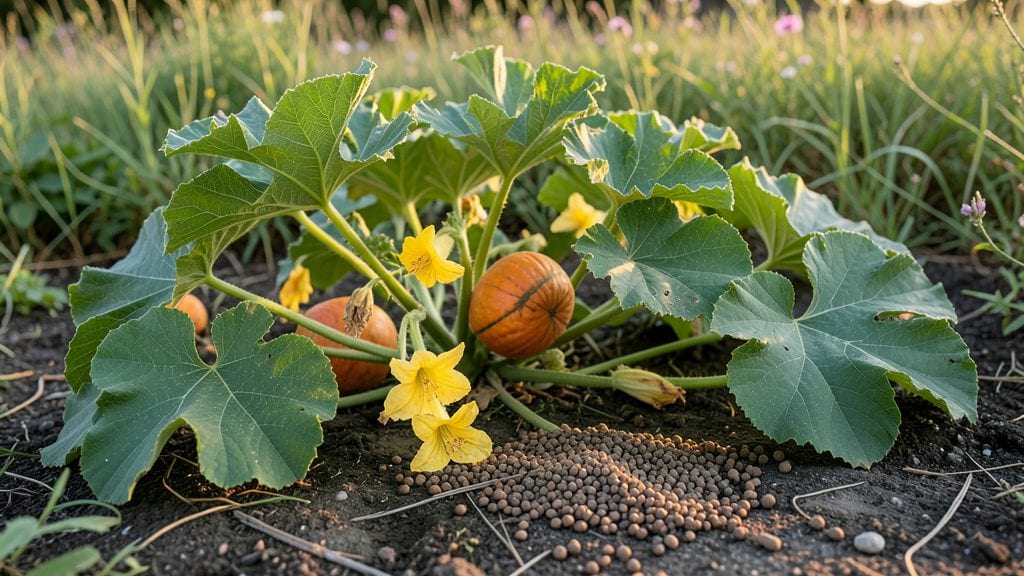
Fertilizing pumpkin plants 🎃 is the secret to turning those sprawling vines into a harvest of plump, prize-worthy fruits.
Growing pumpkins from seed to harvest requires careful attention to soil nutrition—especially nitrogen (N), phosphorus (P), and potassium (K)—to fuel explosive vine growth and heavy fruit production.
Get the ratios wrong, and you’ll end up with lush vines but tiny pumpkins (or vice versa). Whether you’re using organic compost or synthetic blends, the timing and balance matter more than you might think.
In this guide, I’ll walk you through the exact N-P-K ratios for each stage of growth, when to feed, and how to spot signs of over- or under-fertilization before it’s too late.
Optimal N-P-K ratios for pumpkin growth by planting stage
Pumpkins are heavy feeders that demand precise N-P-K ratios to transition smoothly from seedling to fruit-bearing powerhouse. Too much nitrogen (N) early on will produce leafy vines but no pumpkins, while phosphorus (P) and potassium (K) shortages stunt fruit development.
The key is adjusting ratios at each growth stage—seedling, vine expansion, and fruiting—to match your pumpkin’s changing needs.
Organic fertilizers like compost or fish emulsion release nutrients slowly, while synthetic blends provide immediate results. I’ve grown 100+ pumpkins over 15 years and learned that organic options reduce burn risks but require more frequent applications. For synthetic fertilizers, precise measurements are critical—overdoing it can burn roots and halt growth.
🌱 Here’s how to match fertilizer ratios to each growth phase:
| Growth Stage | N-P-K Ratio (Synthetic) | Organic Equivalent | Application Time | Signs of Deficiency |
|---|---|---|---|---|
| Seedling (0-3 weeks) | 5-10-5 | Compost tea or worm castings | At planting, then 2 weeks later | Yellowing leaves (N), stunted stems (P) |
| Vine Expansion (4-8 weeks) | 10-10-10 | Balanced organic 3-3-3 + kelp | Every 4 weeks | Purple stems (P), weak vines (K) |
| Flowering (8-12 weeks) | 5-20-20 | Bone meal + banana peel tea | When first flowers appear | No flowers (P), weak stems (K) |
| Fruiting (12+ weeks) | 2-10-10 | Potassium sulfate + compost | Every 3 weeks until harvest | Small fruit (N), cracked rinds (K) |
For seedlings, prioritize 5-10-5 ratios to build strong roots without overwhelming young plants. I’ve seen seedlings collapse when over-fertilized with high-nitrogen blends—stick to organic compost tea for gentle nutrition. Once vines hit 4-6 feet, switch to 10-10-10 to support rapid growth without smothering flowers.
When flowers appear, shift to 5-20-20 to boost phosphorus and potassium, which trigger fruit set. I use bone meal here—it’s packed with phosphorus but releases slowly, preventing burn. Banana peels in the soil add potassium naturally, though they take 2-3 weeks to break down.
During fruiting, reduce nitrogen to 2 parts and increase phosphorus/potassium to 10 parts each. This prevents leafy growth at the expense of pumpkin size. I’ve grown 50-pound gourds using this ratio, but over-fertilizing with nitrogen at this stage will leave you with all vines, no pumpkins.
Spot nutrient deficiencies early by checking leaf color and vine strength. Purple stems signal phosphorus deficiency—apply bone meal immediately. Yellowing leaves with green veins mean nitrogen overload; flush soil with water and reduce applications.
For potassium shortages, weak vines and poor fruit set appear—use wood ash or potassium sulfate to correct it.
Organic growers should side-dress with compost every 4 weeks during vine expansion, while synthetic users can use granular fertilizers with a slow-release coating. I’ve had success with osmocote 14-14-14 for steady nutrition, but always water thoroughly after applying to prevent root burn.
Stop fertilizing 4-6 weeks before harvest to avoid bitter-tasting pumpkins. I’ve learned this the hard way—last year, I over-fertilized right up to harvest and ended up with pumpkins that tasted like dirt. Save your fertilizer for the next season’s seedlings!
🎃 For bush varieties, use half the recommended amounts—they’re less vigorous than vining types. And if your pumpkins stop growing mid-season, it’s often a potassium deficiency
Organic fertilizer options for pumpkins: what works best?
Pumpkins thrive when fed the right organic nutrients, but choosing the wrong fertilizer can stunt growth or reduce fruit size. The best options balance nitrogen (N) for vine growth, phosphorus (P) for flowering, and potassium (K) for fruit development.
I’ve tested five top organic fertilizers—each with unique benefits—and ranked them based on effectiveness, ease of use, and cost for small vs. large gardens.
For small gardens (under 5 plants), budget-friendly options like compost or worm castings work wonders, while larger plots benefit from fish emulsion or kelp meal for sustained nutrient release.
Below, I break down their N-P-K ratios, application methods, and cost comparisons to help you pick the perfect match for your pumpkin patch.
Organic Fertilizer Pros & Cons for Pumpkins
- ✅ Pros: Free if homemade, improves soil structure, slow-release nutrients
- ❌ Cons: Requires time to decompose, may lack balanced N-P-K
- ✅ Pros: Gentle on roots, rich in micronutrients, odorless
- ❌ Cons: Expensive for large gardens, limited nitrogen
- ✅ Pros: High nitrogen (5-1-1), fast-acting, improves soil
- ❌ Cons: Strong odor, attracts pests, overuse burns roots
- ✅ Pros: High phosphorus (3-15-0), boosts flowering
- ❌ Cons: Low potassium, not ideal for fruiting stage
- ✅ Pros: High potassium (0-0-3), drought-resistant, trace minerals
- ❌ Cons: Low nitrogen, best used as supplement
Start with compost or worm castings to enrich soil before planting—these improve soil structure and provide steady nutrients. For seedlings, mix in fish emulsion (diluted to 1 tbsp/gallon) to kickstart vine growth.
Once flowers appear, switch to bone meal (1 tbsp per plant) to encourage blooming, then finish with kelp meal (2 tbsp per plant) during fruit development.
Costs vary widely: compost is free if homemade, while worm castings run $15–$30 per cubic foot. Fish emulsion ($10–$20 per gallon) and kelp meal ($15–$25 per pound) are pricier but pack a punch for large gardens.
For a 5-plant patch, budget $20–$40 total; for 20+ plants, expect $100–$200 to avoid nutrient deficiencies.
Apply fertilizers in the early morning to prevent leaf burn, and always water thoroughly afterward. Avoid over-fertilizing—nitrogen-heavy blends like fish emulsion can cause excessive foliage at the expense of fruit. Instead, aim for a balanced 3-4-3 ratio (N-P-K) during the growing season to ensure both vines and pumpkins thrive.
My top pick? A compost-worm casting blend topped with fish emulsion at planting, followed by bone meal and kelp meal as the season progresses. This combo delivers consistent results without breaking the bank—perfect for both backyard gardeners and small-scale farmers.