
Planting
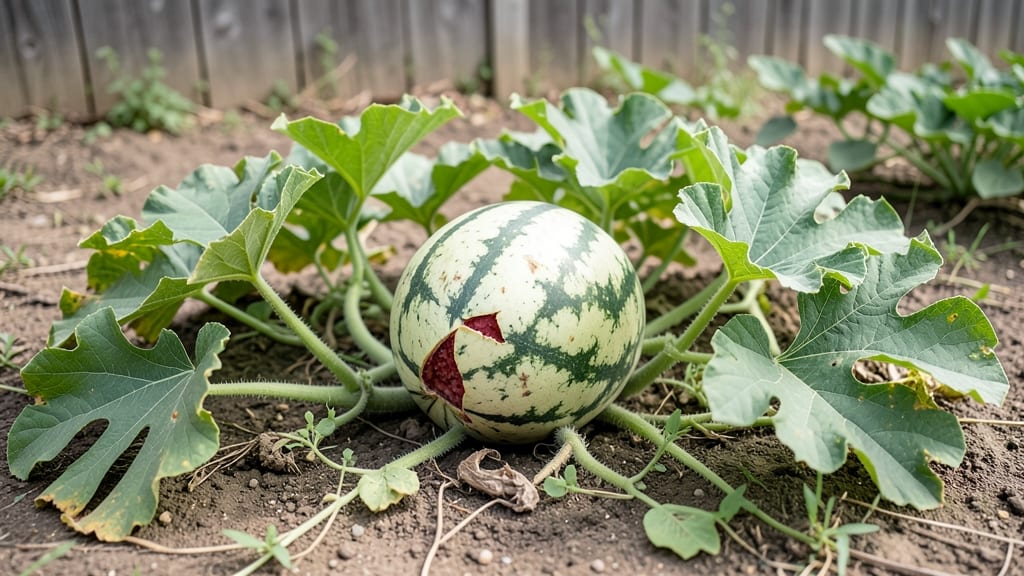
The Jubilee watermelon plant thrives in warm climates and delivers fruit about 75–90 days after planting, with sprawling vines that need full sun and careful spacing. Its growth journey starts with delicate sprouts, progresses through leafy vines and flowering, and culminates in sweet fruit—though the sprawling habit demands patience and strategic support.
The Jubilee watermelon isn't just fast-growing—it's a powerhouse that rewards gardeners who understand its three-phase growth rhythm. 🌱 Early on, those first leaves unfurl like tiny hands reaching for sunlight, while later, the vines stretch aggressively (up to 10 feet) if not contained.
What many miss is how soil temperature below 70°F stalls germination, which is why I always pre-warm seeds in damp paper towels before transplanting.
The real magic happens when vines hit 80°F+, triggering that explosive flowering phase where yellow blooms appear within weeks—then comes the fruit, if you've given it the right conditions.
💡 In This Article
- Jubilee Watermelon Growth Stages Explained
- Maximizing Jubilee Watermelon Yield and Care
Jubilee watermelon growth stages explained
Here's what's actually happening during each of the five distinct phases of Jubilee watermelon development, starting with the germination stage that kicks off when soil temperatures hit 70°F+.
Within 5-10 days of planting pre-soaked seeds, you'll spot the first pale green cotyledons (seed leaves) breaking through the soil—these look like tiny, rounded shields. What's fascinating is how the embryonic root (radicle) grows downward first, anchoring the plant before the shoot emerges upward.
This stage is highly sensitive to moisture fluctuations, which is why maintaining consistent soil dampness (not soggy) is critical for success.
The vegetative stage begins when true leaves appear (10-14 days after germination) and lasts about 3-4 weeks.
During this phase, the vines grow at an astonishing rate of 1-2 feet per week if conditions are ideal, with leaves developing the characteristic deep green color and lobed shape (3-5 pointed lobes).
Here's the key detail: each new leaf node has the potential to produce a flower, but the plant focuses all energy on vine expansion first. You'll notice the vines develop a slightly hairy texture—this isn't just for show; those tiny hairs help regulate moisture and temperature at the leaf surface.
Transitioning to the flowering stage (around 30-40 days after planting), you'll see the first yellow blossoms appear on the vine's underside, typically near leaf axils.
These flowers are perfectly self-pollinating, meaning they contain both male and female reproductive parts, but they open in the morning and close by afternoon—giving you just a few hours daily for pollinators like bees to do their work.
The real giveaway is the tiny green fruit bumps that form within 3-5 days of successful pollination, about the size of a marble. What most gardeners miss is that only 20-30% of flowers actually set fruit due to environmental stress or poor pollination.
The fruiting stage begins when those marble-sized bumps swell rapidly, reaching golf-ball size in 2-3 weeks.
This is when the vines' sprawling habit becomes both a blessing and challenge—they can stretch 6-10 feet if unchecked, but proper trellising at this point can actually increase fruit production by 25% by improving air circulation.
The rind develops its signature dark green stripes against a lighter background, and the fruit's weight causes the vines to sag noticeably. Here's a pro tip: the stripes become more pronounced as the fruit matures, serving as a natural indicator of ripeness alongside the classic "thump" test.
Finally, the maturity stage occurs 75-90 days after planting, when the rind turns from green to a creamy yellow-white ground color with dark green stripes. The tendril nearest the fruit will turn brown and dry out—a clear sign it's time to harvest.
What's often overlooked is how the fruit's sugar content peaks when the vine's leaf nearest the fruit begins yellowing naturally.
At this point, the watermelon's weight should feel substantial (typically 15-25 pounds for Jubilee varieties), and the blossom end (where it attached to the vine) will have a yellowish hue rather than green.
Understanding these stages helps explain why some gardeners get frustrated—skipping proper care during any phase can derail the entire process.
For example, insufficient sunlight during the vegetative stage (less than 6 hours daily) will stunt vine growth, while temperature drops below 60°F during flowering can prevent fruit set entirely.
The science shows that Jubilee watermelons are particularly sensitive to these environmental factors because they're a warm-season crop that evolved in tropical climates. 🌿